Review: Mehdi Parsa, ‘Machinic Ontology’
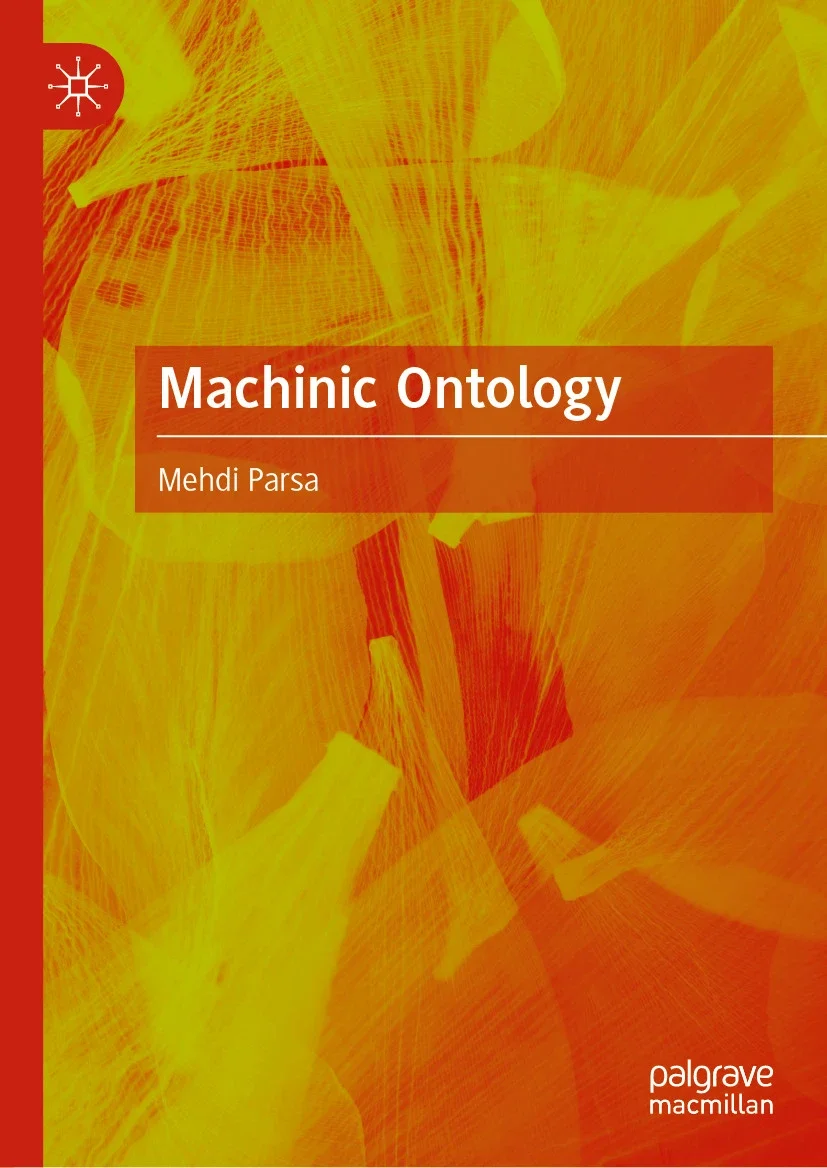
Review of Mehdi Parsa’s Machinic Ontology
(Palgrave Macmillan, 2025) 237 pages
Abstract
The book Machinic Ontology draws parallels between books and brains and indeed models itself on a brain conceived of as a network of problems. A book is also regarded as a little machine, and in echoing Deleuze and Guattari in making this observation, Parsa’s objective in writing the book becomes apparent: it is a detailed evaluation of the becoming-concept of the machine-metaphor, one that applies a universal ‘machinism’ as a metaphysical foundation. This is a hugely important and timely undertaking, though not without various tensions, which will be examined in this review.
Reviewed by Paul Haynes
Notwithstanding Parsa’s claim that his book has no principal idea, and in expressing a scepticism regarding the essentiality of names, the book is a study of conceptual (but no less real) machines, with each of the main chapters describing a machine named alongside the thinker of that machine, with the exception of the absence of Foucault alongside his bio-(politics) machine. The argument underpinning the book is that if the machine has become a predominant concept in contemporary thought, it requires an ontology. The challenge Parsa faces is that not all machines encountered in the book are of equal weight and the dominating presence of Deleuze and Guattari in structuring the organising principle, as well as having been given a core chapter, provides an imbalance to the narrative.
Leaving aside the introduction and conclusion for a moment, the book begins with Descartes, or more specifically the problem of Descartes’ attempt at applying a machinic perspective on the living body, as addressed by George Canguilhem. Canguilhem finds in Descartes a profound unity of organic life and machines, a unity in their functioning and in the machinic (and soulless) nature of life. Canguilhem argues that in comparing natural machines – bodies – to artificial machines, Descartes concludes that the laws of mechanics apply to both, with no essential difference between animals and machines. In this way Canguilhem is able to unify life with artificial knowledge-based engagement in its environment, i.e. the convertibility of life and technics through their inherent creativity. By conceiving ‘living machines’ as pathological and monstrous, Canguilhem derives the notion of the ‘monstrous machine’ and, consequently, nature itself as a monstrous living being, a conception that problematises any such duality of organism and machine.
Parsa links his discussion of Canguilhem with the work of Gilbert Simondon in chapter three, focusing on the concept of transindividual and the process of individuation. Through these processes Simondon presents a historical framework of nature through which life produces technics, and technics produce the human, thus addressing the genesis of the technical object not as a tool but as a machine. The focus on the transindividual machine offers an excellent theme with which to navigate Simondon’s key works (Simondon, 2017; 2020): “Machinic ontology represents the ultimate goal of Simondon’s ontological approach” (94) i.e. a machinic ontogenesis implying a naturalistic perception and characterisation of the machine.
The fourth chapter is nominally concerned with Catherine Malabou’s ‘plastic machine’ concept, exploring the implications of the parallel between the plasticity of the brain and the structure of socio-political life. It is, however, unable to build on the analysis developed in the previous two chapters. This is partly a problem with positioning the argument into the chronology – her work is the most recent of the key thinkers discussed – and partly a function of the limitations of lack of focus exhibited in the chapter. Malabou’s argument hardly appears until the second half of the chapter and when it is discussed, apart from the relevance of the plasticity metaphor, much of the discussion lacks the depth and insight of the previous chapters. Parsa would like Malabou’s argument to be a key contribution to the domain of machinic ontology, but despite summarising five of her most relevant works is somewhat vague concerning what exactly the contribution is to the broad project of the book. There are also incompatibilities between Malabou’s Hegelianism, as manifested in the three major roles of plasticity (developmental plasticity, modulational plasticity, and reparative plasticity) that seem central to plasticity’s fields of action and Deleuze’s ontology of creative forces, irreconcilable with key Hegelian concepts and assumptions.
The fifth, and crucial, chapter is concerned with Deleuze and Guattari’s abstract machine, focused on how they develop a distinctive metaphysical framework derived from the concept of machine. Parsa is an emerging Deleuze scholar of immense perceptiveness and it is in this chapter that the machine is operationalised to examine events, affects and politics. The chapter also provides the clearest, most direct and comprehensive explanation of the concept of a machinic ontology. As Deleuze and Guattari state many times across their two-volume work on Capitalism and Schizophrenia (Deleuze and Guattari, 1984; 1988) everything is a machine, and there are a multiplicity of machines discussed in the chapter: desiring machines, abstract machine, war machines and a proliferation of ‘schizophrenic’ social and natural machines, composed of flows of unconscious desire. Machines produce, and this very act transforms both the machine’s configuration and that of its environment, echoing the observations made by Canguilhem and Simondon, discussed in earlier chapters. For Deleuze and Guattari, however, the implication is that embodied desiring-production and embodied social production are therefore equivalent, operating in accordance with same logic regardless of scale, which, Parsa argues, establishes the basis of a machinic ontology.
The sixth chapter marks a transition from Canguilhem’s ‘machinisation’ of life to the concept of biopolitics, in which social machines operates through modes of life and the aesthetics of existence. Foucault traces the way governing power, biological history and political history become entangled within a bio-machine. The result is biopolitics, which focuses on populations – the social body – as living entities, demanding “a particular form of power whose application shapes the social structure of life” (161). As with the Malabou’s ‘plastic machine’ the machinic character of biopolitics is somewhat marginalised for much of the discussion, while other themes – resistance, democracy, the ‘dispositif’ concept – are examined in an effort to explain the shift from viewing machines primarily as instruments to the ontological endeavour of understanding life grounded in its technicity and thus conceptualising the whole of nature as a machine.
The central chapters therefore offer a cross-referenced evaluation of different machinic concepts suggesting indeed that the machinic concept is one that finds many forms and much resonance within contemporary thought. The challenge is to synthesis these different machinic paradigms to emphasise the argument that they afford or require a new ontology, one ambitious enough to address “subjectivity, consciousness, the unconscious, life and machines” (5). In the introduction (chapter one) the agenda of developing a machinic ontology begins by identifying the need to examine the nature of modern science and its relationship to both society and philosophy, i.e. a revision to the concept of machine able to bridge the abstract and concrete facets of these relationships “as a material ground of structures” (5). Parsa therefore mines from the conceptual machines covered in each chapter in a way that exposes notions with which to fashion his machinic ontology, including:
the fundamental dependency between life and machine in Canguilhem, its extension to the ontogenetic level in Simondon, expanding on its (deep) historical aspect and connecting it to neurotechnicity in Malabou, describing the logic of its functioning as the logic of multiplicities and revealing its revolutionary nature in Deleuze and Guattari, and finally analyzing the ethical-political consequences of this machinic ontology in Foucault and Agamben (7)
These component parts/relationships are further summarised in the introduction to clarify some of the directions and terrain to be navigated; however, the introduction also comprises a detailed review of the work of four additional thinkers (Jane Bennett; Levi Bryant; Arjen Kleinherenbrink; Audronė Žukauskaitė). These literature reviews drift off topic, albeit as a way of demonstrating Parsa’s confidence in positioning his argument against rival lines of reason. Given the complexity and contested nature of his core argument this is unlikely to be the best use of the wordcount. The same applies to the conclusion, which instead of synthesising the argument into a formal conclusion introduces yet another type of machine (dream machines), which takes the reader on another – future oriented and political – journey. Being oriented to the future is likened to a social machine operating as a collective brain, not focused on the past (collective memory) but in the form of a collective dreaming-machine as an opening for resistance and transformation. Presumably, the logic for this concluding reference to the brain is to return to the opening argument that a book is like a brain, but this thought is quickly nullified by the inclusion of two hefty appendices.
How these appendices – one on artist Max Ernst and the other on film maker Béla Tarr – serve the main objective of the book is unclear. The Max Ernst appendix, a chapter-length article first published in Epoché Magazine (Parsa, 2024), engages with core themes associated with Deleuze and Guattari, adding additional evaluation of their conceptual work, while the Tarr appendix, also a chapter length contribution, showcases the films of Béla Tarr to examine political resistance against fascism. While both appendices are interesting and well argued, perhaps greater priority ought to be given to provide more detail on the book’s central argument. Further, in assessing the four reviews in the introduction and the two appendices, the criterion for their inclusion is one of several confusing choices concerning the key thinkers on which the book relies. The absence of Bernard Stiegler is a little surprising, particularly as drawing together the works of Deleuze and Simondon has been developed most effectively by Stiegler in his techno-informational analysis. Other key figures, such as Pierre Klossowski or Maurizio Lazzarato, the latter only briefly mentioned in passing, might have offered a useful counterpoint in grounding core features of the machinic. One final observation is that the book’s main chapters each focus on a French philosopher and the absence of the anglophonic world though perhaps refreshing, disregards a whole alternative tradition. For example, Nick Land have been noteworthy in exploring mechanic ontology for the past three decades (see Land, 1993; 1995) albeit with a much darker purpose.
Nevertheless despite differences of opinion concerning the precise protagonists and antagonists in sourcing the argument, the way that Parsa builds on the work of Deleuze and Guattari in assembling the components of a machinic ontology is persuasive and the project that underpins the book is compelling. Chapters two, three and five are particularly useful in sign-posting the reader to the case for applying the concept of machine to examine the characteristics of existence in its multiplicity of manifestations, while the end of chapter bibliographies provide clear guidance on the shaping of these lines of argument. The book therefore provides a valuable first step in identifying the configuration of a machinic ontology and assessing the implications for a more than human engagement with machinic paradigms.
References
Deleuze G and Guattari F (1984) Anti-Oedipus: Capitalism and Schizophrenia. London: Athlone.
Deleuze G and Guattari F (1988) A Thousand Plateaus: Capitalism and Schizophrenia. London: Athlone
Land N (1993) Machinic desire. Textual Practice 7(3): 471-482.
Land N (1995) Machines and technocultural complexity: The challenge of the Deleuze-Guattari conjunction. Theory, Culture & Society 12(2): 131-140.
Parsa M (2024) Max Ernst and the Schizoanalysis of Nature. Epoché Magazine 74(August). Available at https://epochemagazine.org/74/max-ernst-and-the-schizoanalysis-of-nature/ (accessed 27 November 2025)
Simondon G (2017) On the Mode of Existence of Technical Objects. Minneapolis: Univocal Publishing.
Simondon G (2020) Individuation in Light of Notions of Form and Information. Minneapolis: University of Minnesota Press.
Further Reading
Agamben G (2009) What is an Apparatus? And other Essays. Redwood: Standford University Press.
Bhandar B and Goldberg-Hiller J (2015) Plastic Materialities: Politics, Legality, and Metamorphosis in
the Work of Catherine Malabou. Durham: Duke University Press.
Buchanan I (1997) The problem of the body in Deleuze and Guattari, or, what can a body do? Body & Society 3(3): 73-91.
Canguilhem G (2008) Knowledge of Life. New York: Fordham University Press.
Canguilhem G (1991) The Normal and the Pathological. New York: Zone Books.
Combes M (2012) Gilbert Simondon and the Philosophy of the Transindividual. Cambridge: MIT Press.
Deleuze G (1990) The Logic of Sense. New York: Columbia University Press.
Deleuze G (1994) Difference and Repetition. London: Athlone.
Deleuze G and Guattari F (1984) Anti-Oedipus: Capitalism and Schizophrenia. London: Athlone.
Deleuze G and Guattari F (1988) A Thousand Plateaus: Capitalism and Schizophrenia. London:
Athlone.
Fisher M (2009) Capitalist Realism: Is There No Alternative? Winchester: Zero Books.
Hacking I (1998) Canguilhem amid the cyborgs. Economy and Society. 27(2–3): 202–216.
Lury C and Day, S (2019). Algorithmic personalization as a mode of individuation. Theory, Culture & Society 36(2): 17-37.
Malabou C (2017) The Brain of History, Or, the Mentality of the Anthropocene. South Atlantic
Quarterly 1(116): 39–53.
Malabou C (2008) What Should We Do with Our Brain? New York: Fordham University Press.
Morgan, W. R. (2023). Epigenomics and the Xenoformed Earth: Bioinformatic Ruminations with Gilbert Simondon. Theory, Culture & Society 40(6): 87-106.
Parsa M (2023) A Reading of Gilles Deleuze’s Logic of Sense. London: Palgrave Macmillan.
Pyyhtinen O (2012) Life, death and individuation: Simmel on the problem of life itself. Theory, Culture & Society 29(7-8): 78-100.
Read, J. (2015). The politics of transindividuality. Leiden: Brill.
Revel J (2009) Identity, nature, life: Three biopolitical deconstructions. Theory, Culture & Society
26(6): 45-54.
Simondon G (2017) On the Mode of Existence of Technical Objects. Minneapolis: Univocal
Publishing.
Simondon G (2020) Individuation in Light of Notions of Form and Information. Minneapolis: University
of Minnesota Press.
Stiegler, B. (2022). Megamachines, Forms of Reticulation and the Limits of Calculability. Theory,
Culture & Society 39(7-8): 19-33.
Smith, D. (2018). What is the body without organs? Machine and organism in Deleuze and Guattari.
Continental Philosophy Review 51(1): 95-110.
Paul Haynes is an associate professor of Marketing at the Royal Holloway Business School, London. His core research interests include analysing the impact of consumer culture and networks on innovation and marketing practice. Paul holds an MA from Warwick University and a PhD from Lancaster University, with a thesis that examined complex innovation assemblages and the role of non-linear dynamics in social and technological change.
Email: Paul.haynes@rhul.ac.uk