
Review: Franka Schäfer, ‘Discourse: Event: Practice. Research Program based on the Concept of Events to Overcome the Dichotomy between Theories of Discourse and Practice
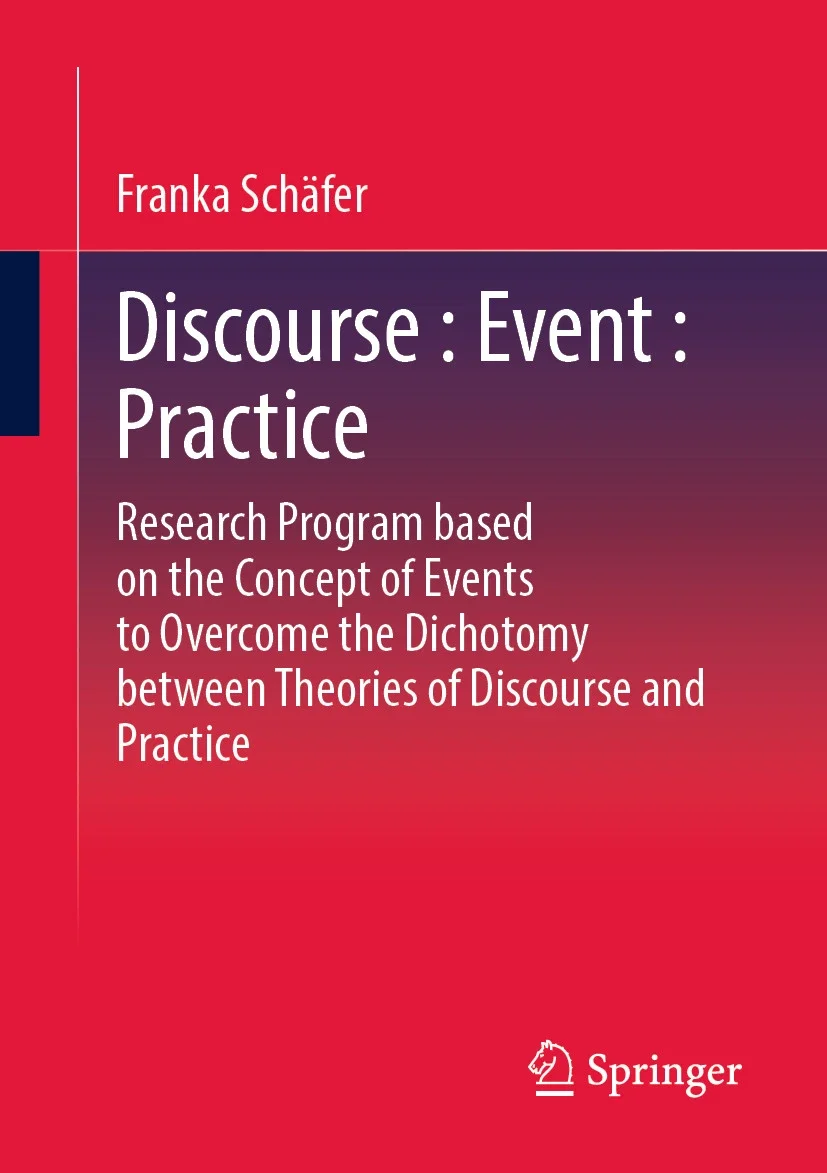
Review of
Franka Schäfer’s Discourse: Event: Practice. Research Program based on the Concept of Events to Overcome the Dichotomy between Theories of Discourse and Practice (Wiesbaden: Springer, 2025) 221 pages
Abstract
Contemporary social theory faces a persistent divide between discourse and practice. Traditional approaches often treat discourse as mere symbolism and practice as physical execution, failing to explain how they shape each other in real-time. This review examines Franka Schäfer’s Discourse: Event: Practice, which bridges this gap by revisiting Michel Foucault’s concept of the “event.” Schäfer argues that social reality is not a fixed backdrop but is constantly reproduced through specific events where language, bodies, and power relations intertwine. While the framework provides a powerful lens for analyzing power and social change, its practical application requires clearer methodological guidelines. Nevertheless, this work offers a significant step toward moving beyond traditional dualisms and deepening our understanding of how discourse and practice operate together.
Reviewed by Yuxiang Duan and Zhen Wang
The relationship between ‘discourse’ (discursive power-knowledge formations) and ‘practice’ (recurrent, materially embedded doings) remains one of the most persistent fault-lines in contemporary social theory (Roch, 2019), precisely because it keeps re-opening the classic dualisms the field claims to have moved beyond (structure vs. agency, meaning vs. materiality, text vs. world) (Cañada, et al., 2022; Orlikowski and Scott, 2023; Raudaskoski, 2021). Discourse theory, particularly in the Foucauldian tradition, holds that language, knowledge, and power shape what we take to be ‘true’ or ‘normal’ (Foucault, 1972). Practice theory, on theother hand, shifts the analytical focus to the ‘doing’ of social life. Building on Bourdieu’s (2013) concept of ‘habitus’ (meaning the ingrained habits, skills, and dispositions that individuals acquire through living in a particular social environment, which guide their actions without conscious calculation) and Giddens’ (2004) theory of ‘structuration’ (which argues that social structures are not external cages but are constantly re-produced through human action), this practice-theoretical strand shifts the focus to the mechanics of “doing” (Reckwitz, 2002; Schatzki, 2002). Here, ‘doing’ is understood technically: a social practice (like commuting, cooking, or coding) is a routinized bundle of activities composed of bodily movements, mental states, objects, and background knowledge (Reckwitz, 2002). For decades, these two intellectual strands, discourse analysis and practice theory, have been regarded as distinct, if not competing, analytical paradigms (Reckwitz, 2002; see also Hillebrandt, 2014). Eventhough Reckwitz (2016) later proposed ‘practice/discourse formations’ to bridge the gap, hiswork largely retains a dualistic perspective: discourse is reduced to supplying symbolic meaning (as in the cultural ideal of private car ownership), while practice is relegated to material performance (as when drivers navigate traffic flows and maintain vehicles). This leaves a fundamental challenge largely unmet: we still lack a framework that captures how power-laden meanings and material doings co-produce each other in real-time. It is precisely to fill this theoretical gap that Schäfer’s monograph under review here is written.
Schäfer’s central claim is that the conventional divide between discourse and practice has grown inadequate. It can no longer explain how the ‘social’, the shifting web of relations connecting us, actually operates. In the current era, marked by digital networks, global interdependence, and the rise of the posthuman condition (where technology and nature are deeply entangled with human life), this web has become far too fluid and complex to be split into separate parts. Earlier efforts to treat practice as merely the ‘non-discursive’ backdrop for discourse, or to simply bolt discourse analysis onto ethnographic observation, miss the generative mechanism at stake: social reality is not a pre-fabricated stage upon which discourse and practice perform; it is recursively produced at the scale of specific events where sayings, bodies, objects, and power relations intra-act (Barad, 2003, 2007; cf. Foucault’sevent-concept in Bouchard, 2013). What feels like a stable order is better understood as the temporary stabilization of a heterogeneous field, one that must be re-made in each event, not merely inherited from a structure. To capture this, Schäfer revives Foucault’s (1977a) later concept of the “event” (événement), understood as the minimal historical-material unit in which discursive and material elements are inseparable. On this view, a statement occurs as a bodily positioning, an architectural constraint, a media-technical relay, and a power-effect all at once (Foucault, 1972, pp. 27-39 on the statement-as-event; Foucault, 1977b on non-discursive arrangements). She then brings this into conversation with Barad’s (2003) agential realism, where entities (e.g., speakers, protesters, police bodies, hashtags) do not pre-exist their relations but are constituted through intertwined struggles where ideas and physical produced together as two sides of the same coin.
Building on this, Schäfer constructs a framework where discourse and practice are never truly distinct. Instead, they co-produce each other within specific moments she identifies as the event. She metaphorically describes this event as a network ‘hub’. While in computing, a hub processes and redirects data from different sources to allow safe user participation, Schäfer repositions this hub from a passive meeting point into a generative site where discourse and practice actively reshape each other. This borrowed schema serves as an analytical device to overcome the binary opposition between discourse and practice theory. In doing so, it movesthe debate beyond mere description toward a clear mechanism for explaining social transformation. For Schäfer, discourse is never merely a way of talking but a contested field of multiple discourses, each vying to fix the definition of the situation and thereby mobilizeinstitutional consequences. Media framings, police classifications, activist vocabularies, juridical categories, each attempting to fix what the event is, who counts as who, and what action counts as what (cf. Foucault, 1972 on the rules of formation that delimit the sayable). The key power relation lies in which of these versions of reality gains dominance and becomesinstitutionally accepted. In this sense, discourse is a material-discursive practice whose classifications are also deployments of force (Foucault, 1977b). The media panic surrounding a protest, for instance, is not commentary about an event, rather, it is part of the event: It re-classifies bodies, triggers mobilisation protocols, reconfigures which spaces become navigable and which become dangerous, and thereby co-determines what subsequent actions are possible. Talk and action are not two layers; they are one event.
The theoretical reframing carries methodological implications. It requires researchers to movebeyond analysing static discursive structures or patterns of practice and instead focus on the dynamic process of eventalization. Specifically, this involves examining how what counts as discourse is always materially lodged (in archives, built environments, trained bodies); and how what counts as practice is always already discursively articulated. The analytical task, therefore, is not to watch one become the other, but to trace their co-constitution within the event. To demonstrate this framework, Schäfer expands the methodological toolkit of practice sociology. Beyond established methods such as video analysis, situational analysis (Clarke, 2005), and multi-sited ethnography, she proposes the innovative use of “docudrama” as an empirical source for analyzing past practices. Her case study of the 1960s American “Yippie Festival of Life” serves as a practical illustration. By focusing on the intersection of fictional andnon-fictional representations, she traces the entanglement of discursive events and non-discursive practices. Through the lens of the event, protest is reconceived not as a mere expression of pre-existing ideology or purely strategic action, but as a practical formation. Within this formation, discursive and material forces operate together within a specific historical hub, generating new subject positions and political possibilities. The work makes three specific contributions to the field. First, it revisits Foucault’s concept of the event to address current theoretical impasses regarding the relationship between discourse and practice. Second, it identifies a gap in practice theory, specifically, the analysis of power, and provides a mechanism to reintroduce this dimension through the event. This insight is pertinent to researchers examining ideology, domination, and resistance. Finally, by integrating posthumanist perspectives on non-human agency, the framework is better equipped to analyse contemporary realities involving technological artifacts and ecological forces.
Nevertheless, the proposed synthesis confronts inherent challenges that also point to the monograph’s limitations. First, the complexity of the event may impede its methodological operationalization. Intended to simultaneously accommodate Foucauldian discontinuity, posthuman assemblages, and practical processuality, the concept requires clearer procedural clarification. Crucial questions persist regarding analytical translation: how does one systematically convert discursive data into practical data within a research design? Are there clear analytical steps or guidelines? Although the Yippie “Festival of Life” serves as an illustrative case, the analysis frequently juxtaposes discursive elements (e.g. media-induced panic) with bodily and material descriptions; it fails to fully demonstrate the unique analytical leverage of the event as a “crossing point”. Second, while the case study effectively clarifies the theory, the book prioritizes theoretical construction over methodological systematization. For a work proposing a new research program, readers may anticipate a more rigorous exposition of the research design, detailing the transition from data collection (how to capture an event) to analytical procedures (how to disentangle and narrate an event). At present, the framework currently functions more as a theoretical provocation than a fully operationalized methodological toolbox. Third, the treatment of the “posthuman” in the book remains mostly at (4) the level of extending the range of actors (non-humans, animals, technologies). Questions concerning how the human itself is redefined within this event-based ontology, and whether such redefinition might weaken the normative foundations necessary for critical sociology, receive relatively scant attention.
In conclusion, Discourse: Event: Practice contributes to contemporary social theory by diagnosing the impasse between discourse and practice and reintroducing power and materiality as central analytical concerns. By establishing the event as a dynamic interface, Schäfer facilitates a dialogue between discourse analysis, practice theory, and posthumanism. While the empirical application and methodological specificity warrant further development, the monograph charts a viable trajectory for future research. For scholars seeking to transcend traditional binaries and analyze power, resistance, and social formation in contemporary settings, engaging with this work represents a substantive intellectual endeavor. The book may not complete the journey, but it maps the terrain for a new theoretical landscape.
References
Barad K (2003) Posthumanist Performativity: Toward an Understanding of How Matter Comes to Matter. Signs: Journal of Women in Culture and Society 28(3): 801–831.
Barad K (2007) Meeting the Universe Halfway: Quantum Physics and the Entanglement of Matter and Meaning. Durham and London: Duke University Press.
Bourdieu P (2013) Outline of a Theory of Practice (R. Nice, Trans.). Cambridge: Cambridge University Press.
Cañada JA, Niska M, and Olakivi A et al (2022) Materiality, affect, and space: Dialogues with discursive social psychology. Beltz Juventa, 69469 Weinheim.
Clarke AE (2005) Situational Analysis: Grounded Theory After the Postmodern Turn. Thousand Oaks. CA: Sage Publications.
Foucault M (1972) The Archaeology of Knowledge (A. M. Sheridan-Smith, Trans.). NewYork: Pantheon.
Foucault M (1977a) Language, Counter-Memory, Practice: Selected Essays and Interviews. Edited by D. F. Bouchard. Ithaca, New York: Cornell University Press.
Foucault M (1977b) Discipline and Punish: The Birth of the Prison (A. Sheridan, Trans.). Pantheon.
Giddens A (2004) The Constitution of Society: Outline of the Theory of Structuration. Cambridge: Polity Press.
Hillebrandt F (2014) Praktiken des Organisierens: Eine praxistheoretische Perspektive auf dasHandeln in Organisationen. Springer VS.
Orlikowski WJ and Scott SV (2023) The digital undertow and institutional displacement: A sociomaterial approach. Organization Theory 4(2).
Raudaskoski PL (2021) Discourse studies and the material turn: From representation (facts) to participation (concerns). Zeitschrift für Diskursforschung 2: 244–269.
Reckwitz A (2002) Toward a Theory of Social Practices: A Development in Culturalist Marxism? European Journal of Social Theory 5(2): 243–263.
Reckwitz A (2016) Die gesellschaftliche Wirklichkeit der Praxis: Grundlagen einer praxeologischen. Soziologie. Suhrkamp Verlag.
Roch J (2019) Exploring the non-discursive: A three-layered approach to discourse and its boundaries. In Fuzzy Boundaries in Discourse Studies: Theoretical, Methodological, and Lexico-Grammatical Fuzziness (pp. 15-36). Cham: Springer International Publishing.
Schatzki TR (2002) The Site of the Social: A Philosophical Account of the Social and Social Individuals. Pennsylvania: Pennsylvania State University Press.
Further reading
Braidotti R (2006) ‘Posthuman, All Too Human: Towards a New Process Ontology’. Theory, Culture & Society 23(7–8).
Elden S, Irrera O and Lorenzini D (2023) ‘Foucault Before the Collège de France’. Theory, Culture & Society 40(1-2).
Johnson E (2008) ‘Simulating Medical Patients and Practices: Bodies and the Construction of Valid Medical Simulators.’ Body & Society 14(3): 105–128.
Lemke T (2015) ‘New Materialisms: Foucault and the “Government of Things’. Theory, Culture & Society 32(4): 3–25.
Lemke T (2021) The Government of Things: Foucault and the New Materialisms. New York: NYU Press.
Acknowledgements
This work has been supported by the 2026 Annual Fundamental Research Project for Universities, Liaoning Provincial Department of Education (Grant No. LJ112610151012); and the 2025 Major Program of the National Social Science Fund of China (Grant No. 25ZD087).
Yuxiang Duan is a lecturer at the School of Foreign Languages, Dalian Maritime University. Her research focuses on sociolinguistics, discourse analysis, digital humanities, and related interdisciplinary fields.
Email: yuxiang.duan@dlmu.edu.cn
Zhen Wang is a lecturer at the School of Chinese Studies · School of Central Asia, Xi’an International Studies University. Her research focuses on sociolinguistics and discourse strategies.
Email: 543651148@qq.com