
Review: Amin Samman, ‘Currency of Nihilism’
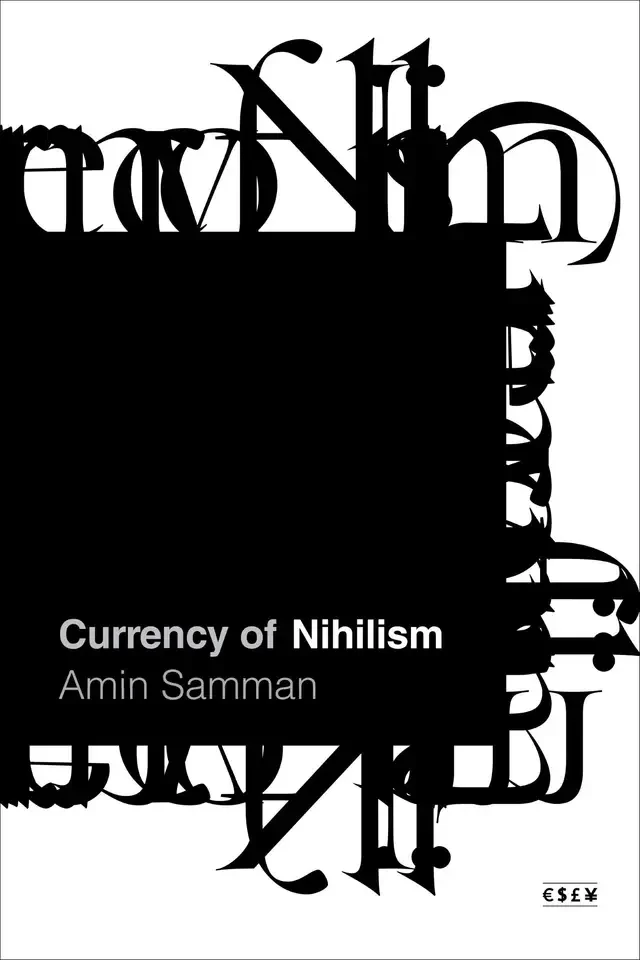
Review of Amin Samman’s Currency of Nihilism
(Stanford University Press, 2026) 178 pages
Abstract
The proliferation of the signs of wealth and speculation—NFTs, cryptocurrencies, and meme coins—has given rise to debates on the relationship between value and meaning. In Currency of Nihilism, Amin Samman interprets these developments through the lens of financial nihilism, arguing that financial markets are characterized by the circulation of signs detached from real meaning and substance. Drawing on Nietzsche and French philosophy, Samman offers a diagnosis of the cultural and existential consequences of this dissolution of meaning. This review reconstructs the strengths of his account while raising questions about its relationship with earlier Marxian critiques of abstraction and fictitious capital.
Reviewed by Fabien Muller
In Currency of Nihilism, Amin Samman offers a pessimistic diagnosis of modern finance. Financial markets, he argues, are driven by a dynamic in which symbols of value are artificially inflated while meaning recedes. Samman’s diagnosis recalls Nietzsche’s account of modernity as “what is coming, what can no longer come differently: the rise of nihilism” (Nietzsche 1954, 634).
Samman’s book combines political economy with philosophy. It extends and builds on his earlier work on the temporal and epistemological structures of capitalism, most notably in History in Financial Times (Samman 2019). His earlier research explores how the history of capitalist financial systems reorganizes notions of value and exchange, showing that history does not evolve in a linear way but reappropriates and transforms its own stages. Currency of Nihilism develops this trajectory further by shifting attention from the question of history to that of meaning.
The core thesis of Currency of Nihilism is that the current symptoms of global financial markets—the febrile and unstable manifestations of algorithmic trading, cryptocurrency speculation, and meme coins—are expressions of nihilism. “Nihilism” is “a tendency or attitude toward annihilation or nothingness” (13-4). The world of finance is affected by nihilism because money reveals itself as increasingly pervaded by nothingness. Of course, money exists in the world and influences human life, but as a sign lacking a concrete, material point of reference in the world, it is ultimately empty, “no-thing” (43). The nihilistic “nothingness” of money becomes more urgent because financial symbols, negotiated through portfolio management and stock exchange, seem to have developed a logic on their own—an irrational, fateful logicdevaluating language and human existence at levels that withstand cultural or ideological analysis. It leads to the weakening of language’s capacity to validate and express meaning, and to the “moods” of voidness and emptiness, which emerge when meaning retreats. Financial nihilism thus makes “thought [think] against itself.” (5)
Samman’s diagnosis is timely. While there is growing fatigue with the omnipresence of the accelerationist, culturally debilitating, corrupt, and often boastful ethos of financial opportunism, there also seems to be a lingering expectation that at some point the system must collapse, simply because it is built on nothing and leads nowhere. Yet it perdures, making the life conditions of many increasingly precarious while multiplying the wealth of the elites. How can such a system endure? For Samman, the void of nihilism grows through eternal recurrence and repetition (67-73), which, in the world of finance, come to realization through assets and portfolio dynamics, where investment generates investment and value generates value. Even though financial nihilism appears to become unsustainable, it survives by negating existing values and absorbing the efforts to resist it.
Samman’s analysis is incisive and rich in references to philosophy and postmodern literature, though this density may pose difficulties for some readers. His pessimism also extends to earlier diagnoses of the sickness of capitalism, which could perhaps have been treated more explicitly as interlocutors. But these aren’t weaknesses of his methodology, but openings for further dialogue with philosophers and economists. Samman’s main argument for the connection between nihilism and financial markets lies in the notion of “currency.” One could be tempted to see in the circulation, exchange, and capitalization of currencies the transformation of a substance. This, however, would amount to a form of foundationalism—which Samman rejects, affirming that “all financial values are without ground or foundation” (79). Yet, nihilism does not simply consist in anti-foundationalism. The empty space of the foundationless financial market is “a space to be excavated, inhabited, perpetuated.” (87) Nihilism is not simply a state but a psychological, existential, and linguistic dynamic that expands and mutates. In late-stage capitalism, such shapes are, for example, cryptocurrencies, meme coins, and the kleptocratic institutions established by tech and AI opportunists. These phenomena slowly spread across social and cultural life, bringing with them a sense of emptiness and absurdity.
Samman develops this argument in an introduction and five chapters. In the introduction and first chapter, he provides conceptual and historical groundwork. His points of reference in his history of nihilism are, in addition to Nietzsche, Lyotard, Baudrillard, and Cioran. In French theory, Samman finds a reconstruction of nihilism in the light of postmodernist critiques of metanarratives. In Baudrillard and Cioran, he sees different responses to nihilism, from the play with appearances in a world stripped of substance and meaning to the complete withdrawal from language.
In the second and third chapters, Samman explains the modalities through which nothingness and voidness emerge from economy. Money is inhabited by tensions and contradictions. It is ungraspable in its circulation and yet attracts desire. Although it is pervaded by voidness and seems to grow out of nothingness, it is treated and amplified as though it were a reality. This also explains why the nihilistic moods it generates are omnipresent and psychologically pervasive: Financial nihilism is born and reborn through the effusion of monetary symbols that seem to indicate a reality, but that, in fact, represent a mere void.
To conclude, Samman presents, in chapters four and five, an immersive exploration of the post-COVID financial market: meme coins, the WallStreeBets subreddit, NFTs, Peter Thiel, the Bored Ape Yacht Club. These disparate phenomena are read as expressions of an underlying current through which financial nihilism grows and expands through a mere amplification of its empty signs and symbols. Although the symbols stand for nothing, they confer power, a power which “reveals itself as hallucination, as the ability to produce and leverage power as an illusion.” (107)
The persuasive strength of Samman’s argument varies across chapters. The “history of nihilism” in the first chapter seems like a necessary exercise but assumes familiarity with Lyotard, Baudrillard, and Cioran. One question that arises is whether the empirical material in the fourth chapter—the most vivid and literary chapter— might have been introduced earlier, allowing uninitiated readers to grasp the stakes of the argument more immediately. Samman’s writing is the strongest when it adopts a more descriptive and almost impressionistic style in depicting the unstable dynamic of speculation and investment.
At times, the philosophical narrative sometimes risks becoming dominant, shifting attention away from finance itself, as for example on p. 25, where a section starts with the sentence: “Baudrillard is a difficult thinker to pin down.” Here the focus briefly shifts from financial nihilism to interpretive issues in philosophical texts on nihilism. While this does not weaken the argument, perhaps some readers will feel that they need to understand the history of philosophy before understanding the dynamic of the finance market they are facing in everyday life.
Two of the questions on which it would be interesting to have Samman develop his argument are Simmel and Marxism.
Simmel has a lot to say about value, abstraction, and the sociology of money. Perhaps the absence of his Philosophy of Money (1900) can be interpreted as a sign that Samman rejects Simmel’s sociological and constructive analysis. Indeed, money has, for Simmel, a constructive function, insofar as the abstraction it creates allows individuals to free themselves from personal bonds, all while remaining connected to the social relations from which the value of money emerges. Simmel’s rejection of value as something reified independently of social relations is an assumption he shares with Samman. Yet Simmel and Samman draw fundamentally different conclusions: for Samman, abstraction creates emptiness and nihilism, while for Simmel, it gives rise to freedom. Since many of Samman’s readers will be familiar with Simmel’s work, it would have been useful to make the relation to Simmel more explicit.
Samman dismisses Marxism as being “inspire[d by] sentimental ideas about inner lives invaded by the inhuman forces of finance” (56). He acknowledges the Marxist critique of the “veil of prices” (6) but likens Marx’s answers to the problem to Nietzsche’s idea of the death of God, presented as the God of capital (68).
But is Marx not specifically interested in processes through which capital and money are detached from production and commodities, thus losing their relation to reality? For example, chapter 24 and 25 of Capital III on fictitious and interest-bearing capital specifically describe forms of circulation in which money begets itself in an empty, fictitious manner: M – M’ (“Geld, das mehr Geld erzeugt,” Marx 1964, 404). Interest generates money without any underlying substance. The “automatic fetish” (“automatischer Fetisch,” ibid.) of these forms of capital leads to “value valorizing itself” (“der sich selbst verwertende Wert,” ibid.) without any increase in the production or commodities. While Marx did not employ the vocabulary of nihilism, he did liken the fetishization of capital (M – M’ as the “pure fetish form of capital,” 405) and money to a religious delusion, a “Kapitalmystifikation” (404) generating hallucinations from nothing. Very much in line with Samman’s concern, Marx is worried that capitalism allows investors to accrue power through symbols of capital disconnected from the lived reality of the proletariat.
Samman nevertheless treats Marxism alongside other currents of economic thought, such as neoclassical or Keynesian approaches (6). Yet one might argue Marx actually anticipates the critique of abstraction that Samman develops. Two reasons may explain Samman’s distance: first, his emphasis on a more apocalyptic and pessimistic framing than Marxism typically allows; second, his Baudrillardian starting point, which privileges signs over production, or assumes that describing the voidness of finance in terms of production would be reductive—a “spectre,” as Baudrillard himself writes (Baudrillard 1973, 7).
One can understand that making this connection explicit would have led Samman away from his diagnosis of nihilism and theoretical framing. Thus, the present reviewer presents this question as a perspective for a discussion with Samman rather than a critique. But the question remains whether financial nihilism is best understood as a new, apocalyptic condition or as a rearticulation of already existing critiques of capitalism. In the latter case, productive connections with those critiques would emerge. Financial nihilism would not be apocalyptic anymore, but one would be able to discern ways to dissipate the mystification that Marx sees in the circulation of capital.
Samman’s book is a timely, well-written, erudite, and valuable contribution to the study of financial markets, money, and economy. Its interdisciplinarity is one of its main strengths, allowing philosophical analysis to illuminate aspects of finance that are often obscured by technical terms. At the same time, the idea of financial nihilism adds explanatory depth to existing critiques of capitalism, leaving the possibility of a dialogue with those critiques open. This openness is, perhaps, where its most important contribution lies.
Bibliography
Nietzsche, F. (1954) Werke in drei Bänden. Vol 3. München: Carl Hanser Verlag.
Marx, K. & Engels, F. (1964) Werke. Vol 25. Berlin: Karl Dietz Verlag.
Baudrillard, J. (1973) Le miroir de la production. Paris: Castermann.
Samman, A. (2019) History in Financial Times. Redwood City: Stanford University Press.
Simmel, G. (1989 [1900]) Philosophie des Geldes. Gesamtausgabe. Vol. 6. Ed. by D.P. Frisby and K.C.
Köhnke. Frankfurt am Main: Suhrkamp.
Fabien Muller is a Postdoctoral Research Fellow in the “Program in the Study of Mysticism” at Tampere University, Finland. He specializes in the history of metaphysics in Greek, Indian, and continental contexts, as well as in Marxist philosophy and counterculture. He most recently published a translation of Porphyry of Tyre’s texts on the philosophy of religion (Harvard University Press, 2026).
Email: fabien.muller@tuni.fi